Chain Selection Is a Strategic Decision: Evaluating Today's Leading Blockchain Networks for Real-World Utility
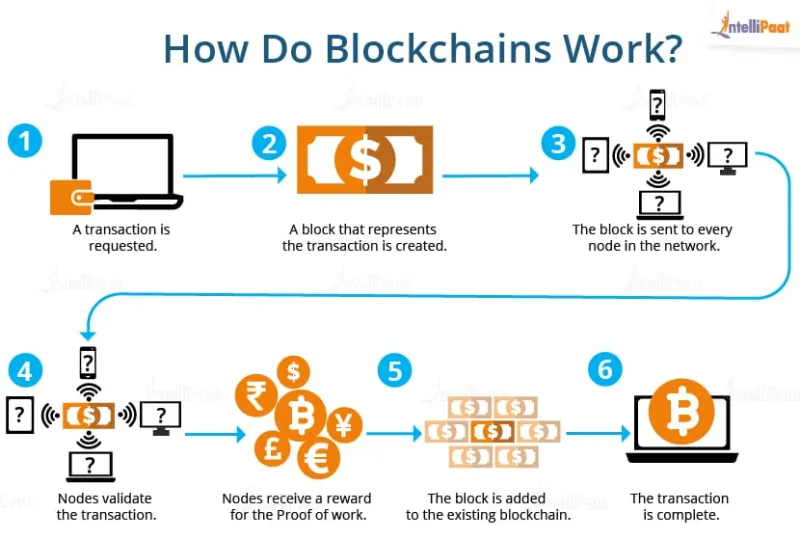
Photo: blockchain network comparison digital infrastructure nodes technology abstract, via intellipaat.com
The proliferation of blockchain networks over the past several years has produced a landscape that is simultaneously rich with opportunity and difficult to navigate. For US-based participants in on-chain commerce—whether trading digital assets, collecting NFTs, or deploying capital into decentralized protocols—the question of which chain is no longer academic. It is a practical decision with real financial consequences measured in transaction costs, execution speed, counterparty risk, and ecosystem liquidity.
This analysis evaluates the most relevant networks not by market capitalization or social media momentum, but by the criteria that matter for actual utility: speed, cost, security, and the maturity of the surrounding ecosystem.
Ethereum: The Incumbent with Persistent Advantages
Any honest evaluation must begin with Ethereum, not because it is the most efficient network for every purpose, but because it remains the gravitational center of decentralized finance and the NFT market. Despite years of competition from faster and cheaper alternatives, Ethereum mainnet continues to host the deepest liquidity pools, the most audited smart contracts, and the widest institutional participation of any decentralized network.
The transition to proof-of-stake in 2022 reduced Ethereum's energy consumption dramatically and improved its long-term sustainability narrative. However, mainnet transaction fees—commonly referred to as gas costs—remain prohibitive for high-frequency activity. During periods of network congestion, a single DeFi swap can cost upward of $30 to $80. For large transactions where precision and settlement finality are paramount, this cost is often acceptable. For routine activity or smaller positions, it is not.
Best suited for: Large-value DeFi transactions, blue-chip NFT trading, and any use case where contract security and liquidity depth are non-negotiable.
Solana: Speed as a Feature, Reliability as a Concern
Solana's technical architecture—specifically its proof-of-history consensus mechanism—enables transaction throughput that dwarfs Ethereum mainnet, with fees that typically remain below a fraction of a cent. For traders executing high volumes of transactions, this cost structure is genuinely transformative. Solana's NFT ecosystem has matured considerably, with platforms supporting robust secondary market activity and a growing base of collectors.
The network's vulnerability, however, is its historical instability. Solana has experienced multiple significant outages over its operational history, events that would be unacceptable on a network handling time-sensitive financial activity. The development team has made meaningful progress on network resilience, and recent months have demonstrated improved uptime. Nevertheless, traders allocating capital to Solana-based protocols should maintain awareness of this risk profile.
Best suited for: High-frequency NFT trading, consumer-facing applications where low fees improve user experience, and DeFi activity where speed is prioritized over maximum decentralization.
Polygon: The Practical Workhorse
Polygon occupies a distinctive position in the ecosystem. As an Ethereum-compatible Layer 2 network, it offers dramatically reduced transaction costs while maintaining compatibility with Ethereum's development tooling and token standards. This compatibility has made Polygon the preferred network for numerous enterprise blockchain integrations, gaming applications, and NFT projects targeting mainstream audiences.
For traders, Polygon's strengths are its predictable fee structure and the breadth of supported assets. Its weaknesses include lower liquidity compared to Ethereum mainnet and a degree of centralization in its validator set that more decentralization-focused participants may find objectionable. The network's continued development, including its evolution toward a ZK-based architecture, suggests a credible long-term roadmap.
Best suited for: NFT projects targeting wider audiences, gaming and metaverse applications, and merchants integrating crypto payments where low fees are essential.
Arbitrum: Ethereum's Most Mature Scaling Solution
Among the Ethereum Layer 2 networks, Arbitrum has emerged as arguably the most mature for DeFi activity. Its optimistic rollup architecture inherits significant security guarantees from Ethereum mainnet while delivering transaction costs that are typically 90% lower than mainnet equivalents. The Arbitrum ecosystem hosts a substantial number of established DeFi protocols, including several that have migrated significant liquidity from mainnet.
For traders whose primary activity involves decentralized exchanges, lending protocols, or derivatives platforms, Arbitrum represents a compelling balance between cost efficiency and security. The primary limitation is a withdrawal delay inherent to optimistic rollup design—moving assets back to Ethereum mainnet requires a challenge period that can extend up to seven days, though liquidity bridges can circumvent this at additional cost.
Best suited for: Active DeFi participants, yield-seeking capital deployment, and traders who want Ethereum-level security at a fraction of the cost.
Base: The Institutional Entry Point
Coinbase's Base network, launched in mid-2023, has attracted considerable attention not primarily because of its technical specifications—it is also an optimistic rollup, sharing architectural similarities with Arbitrum and Optimism—but because of its institutional backing and the distribution advantages that come with Coinbase's existing user base.
Base has grown its ecosystem rapidly, and its integration with Coinbase's consumer products creates onboarding pathways that other networks cannot easily replicate. For traders and developers seeking exposure to a network with regulatory-conscious infrastructure and a credible institutional sponsor, Base merits serious consideration. Its relatively young ecosystem does mean that liquidity and protocol maturity lag behind more established networks.
Best suited for: Traders entering DeFi from centralized exchange backgrounds, developers building consumer applications, and participants who value institutional infrastructure.
Making the Strategic Choice
The framing of a single "best" blockchain network is a false premise. The more productive question is: which network best serves a specific objective at a specific point in time?
For on-chain commerce and NFT activity at B8C Store and similar platforms, the following principles apply:
- Prioritize Ethereum mainnet when transacting in high-value assets where settlement finality and maximum liquidity depth justify the cost.
- Use Arbitrum or Base for regular DeFi activity where Ethereum-compatible security at lower cost is the priority.
- Consider Solana for high-volume NFT trading where fee minimization is critical and you have assessed the network's reliability risk.
- Deploy Polygon for applications requiring broad accessibility or merchant payment integration.
Chain selection is ultimately a risk management decision as much as a cost optimization exercise. The networks that deliver genuine value are those whose security models, liquidity environments, and ecosystem depth align with the specific demands of your on-chain activity. In 2024, the infrastructure exists to make sophisticated multi-chain participation practical—but only for those willing to evaluate each network on its actual merits rather than its marketing narrative.